Field notes / Small business
3 Hidden AI Threats We Keep Finding in Small Businesses
What we keep running into while supporting solopreneurs and small businesses, and why AI alone doesn't close the gap.
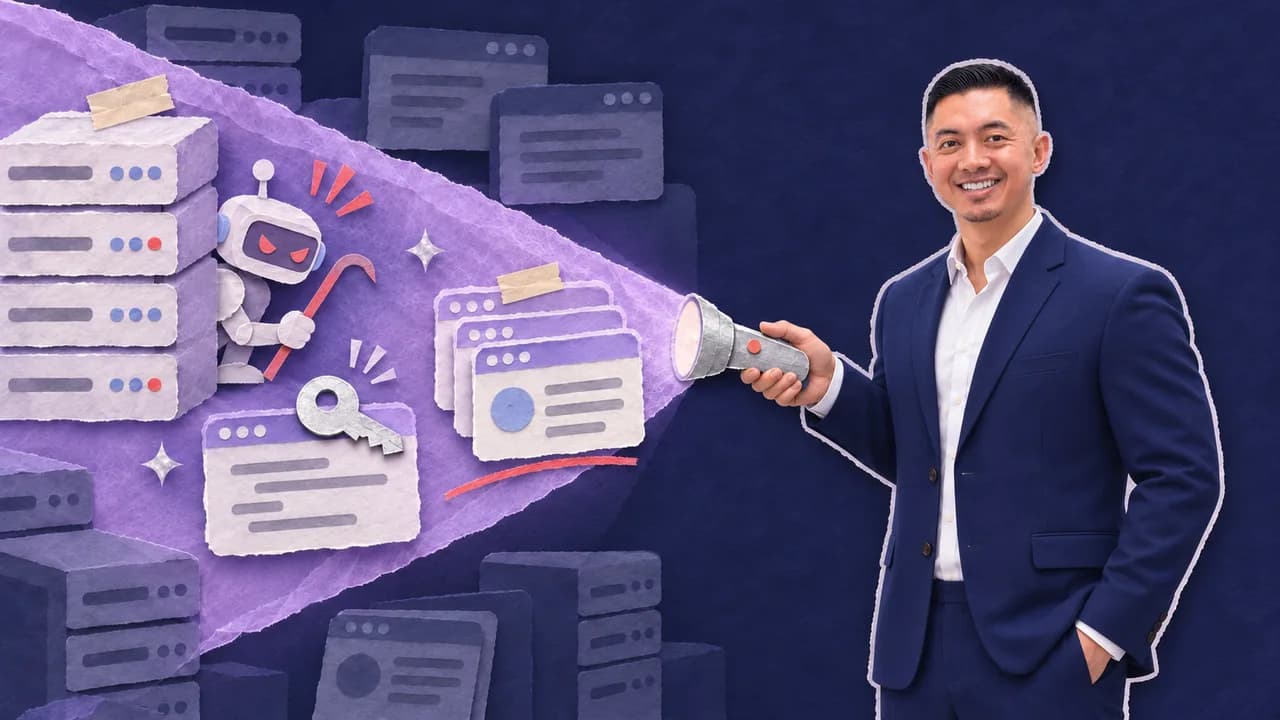
Sam Altman has said he and his tech CEO friends have a betting pool "for the first year that there is a one-person billion-dollar company."[1] In April 2026, The New York Times profiled Medvi. Its founder started it with two months, $20,000 and more than a dozen AI tools. With his brother as his only employee, the company was on track for $1.8 billion in sales in 2026.[2]
A lot of people are calling this the year of the solopreneur. I think that's right. One person really can build a seven or eight figure company now. But there's a lot that person has to have for it to happen. They can't just be AI pilled. They need the drive. They need business knowledge and experience. They have to be somewhat technical, they have to know how to market, and they have to be good at sales. Even the Medvi founder, by the Times' account, "outsourced the other stuff he couldn't do himself."[2] Unless you get lucky, you still need all of it.
AI definitely helps with that. From what I've seen, though, there's still a big gap between someone who can become a seven figure solopreneur and someone who watches a YouTube video telling them they can and then tries to be one.
Larger organizations deal with all of this too, but this is my view from supporting solopreneurs and small businesses, and these are the 3 dangers that keep popping up.
1. Distraction
I wrote about this in an earlier post, Tune out the AI noise, but it keeps coming up. AI is such a powerful tool that it has an almost endless number of applications, and it lets people do things they weren't able to do before. That's also what pulls people off course.
We run into it often. Someone builds an app and they're like, "Whoa, I built an app. It's amazing. It solves a problem." That's when I tell them to see if it exists first, because 99% of the time, it does. It might not be well known, but someone has most likely tried it before. GitHub now serves more than 225 million developers, and the commits they pushed nearly tripled in a year, to 34.3 billion.[3] With that many people building, the odds that nobody has tried your idea are pretty low.
That's a big reason I'm bullish on open source. So instead of starting from scratch, or thinking I have such a unique idea, why not take the head start someone else gave me and start ahead?
Then I tell them to get back to what that app was meant to do for them: keep their business moving in the direction that, a lot of the time, was already working.
2. Hallucination, the human kind
The second threat is hallucination. You could also call it overconfidence, or relying on AI too much, but everyone's heard of AI hallucinating, so hallucination sounded cooler. The version I keep running into is human, and it builds off the first one. A lot of people get caught up in the rush of what they're able to do with AI. They start to believe they're AI experts, or that they're technical enough to be.
A lot of our intro calls start with someone telling us, "I already use AI," or "I'm already very AI forward." A study from Aalto University fits what I hear on those calls. People who used AI to solve reasoning problems overestimated how well they did across the board, and the ones who considered themselves more AI literate were the most overconfident.[4]
Then there's the other extreme. Some people hear what we do, decide they can do it too, and try to shift their business into our model. I'm not exaggerating: at least five companies we started helping or engaged with have moved into this, or started a new company doing it. None of the five has worked out.
A lot of them were more technical than I am. Several had software engineering backgrounds. I just don't think that's the most important thing anymore. I think it's creativity and applied AI. It's experience in business growth and operations, and all the functions around them, like marketing and sales. AI doesn't teach you empathy. AI doesn't teach you how to read people. AI doesn't teach you culture. AI doesn't teach you adaptability, perseverance or patience.
My background is in operations, growth and cybersecurity, and infrastructure and hardware have always been my hobby. That mix is what lets me see how things work together and get creative in my prompting, in what I ask for, in what I make AI do and in what I build. AI is a tool, and it takes a lot of things working around it to make it effective.
3. Cybersecurity
The last one is probably the most common, but I still think it's the most important. A recent breach at a company we work with is what got me to write this post.
AI is a very helpful tool, but in the wrong hands it's also very good at causing harm. The same way people can build and deploy quickly now, attackers can scan, write scripts, inject scripts and phish at a much larger scale, and find weaknesses people don't know are there.
Anthropic's September 2026 threat report says exposed access tokens are now discovered "at industrial scale" by automated tools that comb through code repositories and client side code. In one case, a compromise went from a single stolen developer token to full administrative control of a victim's cloud environment in roughly three hours.[5]
That's close to what happened at that company. A team member noticed something off, and they reached out to us while it was still going. The attack was moving at machine speed. In about three hours, it pushed attack code into several of their repositories, slipped a script into a live website that sent every visitor's browser data to an outside server, and fired roughly 90,000 requests at their other apps, most of them password guesses. It even numbered its own probes as it went.
It started with an access key that had ended up in a website's public code, where anyone could read it. Twelve days earlier, automated tools had found it and used it to copy every code repository the company had, more than 100 downloads from addresses in four countries. Nobody had noticed. It followed the playbook in Anthropic's report almost step for step: find an exposed key in public code, then use it to reach everything it can, as fast as it can.
We shut most of it down that night. The apps we host for them held, and none of the password guessing got in. Our own AI agent did most of the investigation, with us directing it, because the same tools work on defense if you know where to point them.
Keys left in public code are an old, ordinary mistake, but now AI finds them and uses them much faster. A lot of the businesses we run into haven't caught up to that. Many have been around for a long time, and their infrastructure hasn't kept pace with the leap AI has made. Security practices that were acceptable back then are nowhere near enough for what AI lets attackers do today. Verizon's 2026 Data Breach Investigations Report found that exploiting vulnerabilities is now the most common way breaches start, at 31%, and that about 96% of ransomware victims whose size was known were small and medium-sized businesses.[6]
Nothing about that breach was new except the speed, so the fix is mostly the basics, done everywhere and checked often:
- Turn on two-factor sign-in for everything, including where your code lives.
- Keep keys and passwords out of code, and scan for any that slipped in.
- Patch anything that faces the internet within days.
- Have someone watching your logs who knows what an attack looks like.
This is another reason I strongly disagree that anyone can just learn AI and build a company around it. Even if AI fills a lot of the knowledge gaps, you still have to know the right questions to ask and the right prompts to write. Knowing what to ask is how we traced that attack through everything it touched.
If you want a second set of eyes on where AI fits in your business, or on your AI governance and security, book a free 15-minute intro with us.
Galang AI newsletter
Practical AI, from the field
New Down To A Science episodes, Galang AI news and our latest guides, in one short email on Mondays when there's something new. The first Monday of each month adds a longer note on what we built, what worked and what didn't.
Sources
- [1]Sam Altman wants AI to create a one-person unicorn with a billion-dollar valuation (February 4, 2024) (Fortune), retrieved . https://fortune.com/2024/02/04/sam-altman-one-person-unicorn-silicon-valley-founder-myth
- [2]How A.I. Helped One Man (and His Brother) Build a $1.8 Billion Company (April 2, 2026) (The New York Times), retrieved . https://www.nytimes.com/2026/04/02/technology/ai-billion-dollar-company-medvi.html
- [3]Octoverse: Commits, pushes reach new highs in 2026 as developers build with agents (October 28, 2026) (GitHub), retrieved . https://github.blog/news-insights/octoverse/octoverse-commits-pushes-reach-new-highs-in-2026-as-developers-build-with-agents
- [4]AI use makes us overestimate our cognitive performance (October 29, 2025) (Aalto University), retrieved . https://www.aalto.fi/en/news/ai-use-makes-us-overestimate-our-cognitive-performance
- [5]Detecting and countering misuse of AI: September 2026 (Anthropic), retrieved . https://www.anthropic.com/threat-intelligence-report-september-2026
- [6]2026 Data Breach Investigations Report (Verizon), retrieved . https://www.verizon.com/business/resources/reports/dbir/
Related reading
- Responsible AI governance consultingTurning AI policies into inventories, risk tiers, evaluations, approval controls and audit evidence.
- Tune out the AI noise and get stuff doneWhy AI hype and doom headlines are both distractions, and four questions to ask before adding a new AI tool.
- AI took away the hard part of open sourceHow an AI agent now handles the upkeep that kept most businesses off open source software, and the security work you cannot skip.